


It’s true for marketing strategies and budgets alike: managing and optimizing channels in isolation doesn’t deliver optimal results. If you want a marketing budget plan that delivers both value and performance, you need a single system built on shared analytics.
Here, we’ve put together a holistic guide on combining analytics, SEO, paid media, content marketing, and CRO into a pain-point-specific budget strategy.
In this guide:
- Key Takeaways
- The Three Dimensions of Digital Marketing Budget Allocation
- Digital Marketing Budget Costs
- Why Analytics Is the Foundation of Every Channel Decision
- Key Metrics That Should Drive Your Allocation Decisions
- Attribution Modeling in the Age of AI Search and Zero-Click Results
- The 70/20/10 Rule for Marketing Budget Allocation
- Digital Marketing Budget Allocation by Channel
- Allocating Budget by Business Goal and Market Position
- Allocating Budget Across the Marketing Funnel
- How to Determine Your Total Marketing Budget
- Reserving Budget for Testing New Channels
- Building an Integrated Budget Strategy Across Channels
- Conclusion
Key Takeaways
- Start with business goals and market position, since they determine how budget should be weighted across awareness, consideration, and retention
- Translate those priorities into allocation decisions by mapping every dollar to a channel and a funnel stage, not just a channel
- Make the allocation accurate by counting the full cost of marketing, including salaries, itemized agency fees, media spend, and software
- Measure whether the allocation is working with a strong analytics foundation, judging each channel on CAC, ROI, and LTV together
- Keep that measurement reliable as AI search reduces clicks by adding marketing mix modeling and brand lift, and fund new tests through 70/20/10
The Three Dimensions of Digital Marketing Budget Allocation
Based on our extensive experience advising enterprises, the approach we recommend is marketing budgeting allocation based around three dimensions: channels, funnel stages, and business goals.
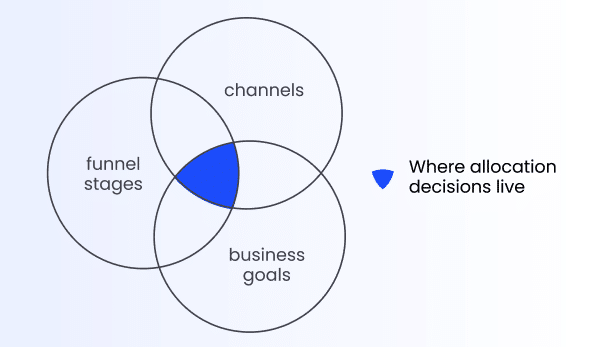
Thinking about these dimensions instead of only about channels enables you to be far more strategic. It forces you to think more critically about not just where you’re allocating budget but why. Tying these decisions to strategic goals means your marketing budget actively facilitates achieving those goals.
1. Channel Selection
The first and most obvious dimension is the marketing channel. Here, you’ll want to consider which channels have proven performance, fit your audience, and tie into your broader marketing strategy.
Thinking about all of these elements together is important because a channel might have outstanding performance, but if it doesn’t tie into your broader strategy then throwing money at it isn’t going to bring the results you want. It’s like having an incredibly fast car that doesn’t go in the right direction: all that speed ends up wasted.
2. Funnel Stage
If you’re basing your marketing budget allocation on how well channels fit into your marketing strategy, then you also need to think about the funnel stages within those channels.
Based on that strategy, consider how much budget to allocate towards awareness, consideration and decision activities within your channels. Of course this can and should evolve over time, but starting with a baseline strategic idea of priorities will help immensely.
3. Business Goals
Your marketing budget allocation should also be based on your strategic business goals. In fact, they should be the foundation of your entire allocation approach. Consider what your main objectives are for your marketing: acquisition, retention, brand awareness, etc.
As you think about your marketing budget allocation for specific funnel stages and channels, the question you’ll need to consistently answer is “does this allocation help us achieve our business goals?” After all, it’s shockingly easy to forget the big picture and get distracted by something like channel performance while forgetting the actual goals you’re trying to achieve.
Digital Marketing Budget Costs
Creating that initial marketing budget allocation is only the beginning, you still need to break down that spending based on specific costs.
A common mistake to avoid here is mistaking your marketing budget for the advertising budget that makes up just one part of it. Like with the initial allocation, a big-picture strategic approach is essential. Here’s a breakdown of the individual costs you’ll need to consider along with tips on bringing it all together in a strategic way.
Salaries and Internal Team Costs
It’s easy to either leave salaries and team costs out of your marketing budget (that’s for HR right?) or take them as fixed. But either approach is a missed opportunity. Internal team salaries are a real marketing cost and excluding them distorts the true ROI and cost-per-channel calculations that make up any marketing budget plan.
So while you probably won’t be adjusting salaries based on which channels, funnels, etc. you want to focus on, ensuring those costs are considered when calculating things like ROI is essential.
Agency Costs
If you work with an external marketing agency, factoring in the costs associated with that relationship takes more than a single line item. Condensing everything into a single line item makes it more difficult to factor these costs into ROI calculations for individual channels, projects, etc.
We would recommend getting itemized invoices and splitting those costs among channels, funnel stages, and business goals to fully understand their impact. This also gives you greater visibility into the value that agency provides, helping you shape the relationship so it can contribute towards your strategic goals more effectively.
Campaign-Specific Spend
When it comes to campaign spending, condensing it all into a single line item in your marketing budget makes that budget far less strategic. Instead, by separating time-bound campaigns like product launches from always-on spend you can get a clearer picture of what spending is actually contributing to your goals.
Breaking down campaign-specific spending within your marketing budget plan and allocating it to specific channels, funnel stages, and business goals will help you understand where you’re getting value.
Always-On Media Spend
It’s incredibly easy to take a “set it and forget it” approach to always-on media spend. But doing so also makes it easy to divorce that spending from the goals it should be achieving. Tying always-on media spend to specific performance-based metrics that are themselves tied to strategic business goals helps you calibrate that spending effectively within your overall marketing budget.
Software and Marketing Technology Subscriptions
Organizations waste truly incredible amounts of money on software and marketing technology subscriptions that don’t genuinely contribute to their strategic goals. That’s why any marketing budget plan should contain an audit of existing software costs. It’s an opportunity to identify redundant subscriptions and tie what you are spending to specific channels, funnel stages, and strategic goals.
The result is less waste and a better understanding of the value you’re actually deriving from these subscriptions.
Why Analytics Is the Foundation of Every Channel Decision
There are a few basic principles of marketing budget allocation that point to the importance of analytics. The first is that your spending should contribute to achieving your strategic goals. The second is that the only way to know whether or not that’s happening is through analytics.
Put another way, every single one of your decisions around SEO, paid media, content, CRO, and more is only as good as the analytics infrastructure measuring them. Making those analytics an afterthought leads to more waste and less strategic spending. It becomes far easier to waste resources on channels, campaigns, funnel stages, etc. that aren’t helping you achieve your goals.
So before you ask yourself how to allocate a budget for digital marketing, ask yourself whether your analytics are where they need to be. Taking the time to get analytics right first makes every other step of the process that much easier.
Key Metrics That Should Drive Your Allocation Decisions
Knowing that analytics should be the foundation of your marketing budget plan is one thing, actually determining which metrics should make up those analytics is another. Based on our experience creating marketing budget plans for ourselves and our clients, there are three core metrics that should drive your allocation decisions: CAC, ROI, and LTV. Here’s a breakdown of each.
Customer Acquisition Cost (CAC)
CAC measures the cost of acquiring a customer. It sounds straightforward, but getting attribution right to accurately measure it across funnel stages, campaigns, etc. can be a huge challenge.
But that challenge is well worth it because having an accurate sense of CAC broken down by channel helps you allocate more efficiently. For example, if CAC on a channel is increasing, it’s probably time to reallocate some of that budget elsewhere.
Return on Investment (ROI)
Calculating ROI based on individual channels makes it possible to understand which ones are efficiently contributing to your bottom line. That knowledge in turn can drive marketing budget allocation decisions. The result is an overall budget that spends wisely to literally do more with less.
But all of that is only possible when you begin with quality analytics and break down your marketing budget by channel, funnel stage, and strategic goals. After all, the “return” part of ROI might be simply revenue but it might also be a less tangible metric tied to a strategic goal.
Lifetime Value (LTV)
The final core metric that should drive your marketing allocation decisions is LTV. This number should always be viewed alongside CAC because the two directly inform each other. High LTV means less when the cost to acquire that customer is high. Likewise, a channel might be acquiring customers at a low cost, but that can be outweighed by a low LTV.
Attribution Modeling in the Age of AI Search and Zero-Click Results
Attribution has never been easy, but the onset of AI search and zero-click results has only made it more difficult and complex. However, while it can be tempting to believe that attribution in these situations is impossible, there are still ways to learn how people are finding your brand and use that data for your marketing budget allocation.
Why AI Overviews and Zero-Click Search Break Traditional Attribution
With more people using AI to search, they’re getting results that often don’t include direct links. Likewise, search engines like Google increasingly offer answers directly, resulting in fewer clicks to results. All this makes it extremely difficult, but not impossible, to know that the resulting traffic can be attributed to AI or a Google search because there’s no direct digital signal of that connection.
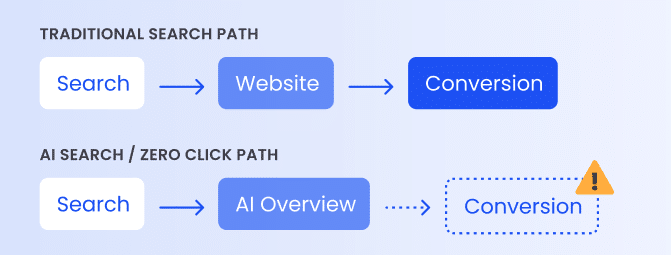
If your attribution model doesn’t account for this, it’s likely far less effective than it used to be. That’s why it’s important to do things like ask customers where they heard about you to gather attribution data in other ways that avoid these new challenges.
Why Marketing Mix Modeling and Brand Lift Matter
With standard attribution becoming increasingly insufficient, relying more on Marketing Mix Modeling (MMM) and brand lift helps compensate. MMM aggregates historical data instead of tracking individual users, making it easier to factor things like offline media or zero-click searches into your attribution.
Brand lift looks at things like brand awareness and purchase intent, leveraging controlled survey groups to determine whether things like top-of-funnel ads are working even if they aren’t producing clicks directly. Together with traditional attribution, you can create a holistic overall measurement framework that’s more resistant to today’s attribution challenges.
Common Attribution Models
When factoring attribution into your marketing budget plan, it’s helpful to use a variety of attribution models to further compensate for deficiencies some have. Again, a holistic overall approach creates a far better outcome. Here are some common models to be aware of:
First-touch attribution: This model gives 100% of the conversion credit based on the user’s first interaction or touchpoint with the brand. This is straightforward but ignores all the middle-funnel nurturing and final closing actions.

Last-touch attribution: This model instead gives 100% of the credit for a conversion based on the last touchpoint of a customer journey. Like first-touch, it’s simple and easy to track but misses a lot of important context.

Linear attribution: Instead of attributing everything to the first or last touch, linear attribution distributes credit equally to every interaction a customer has before a conversion. Again, it’s straightforward but lacks nuance.

Time-decay attribution: The time-decay approach factors in all touchpoints but gives those closer to the final conversion greater weight. That can work well for long and complex sales cycles but it often undervalues awareness efforts.

Position-based attribution: A more balanced attribution model, this one gives 40% of the credit to the first touch, 40% to the last touch, and distributes the remaining 20% amongst all middle touches.

The 70/20/10 Rule for Marketing Budget Allocation
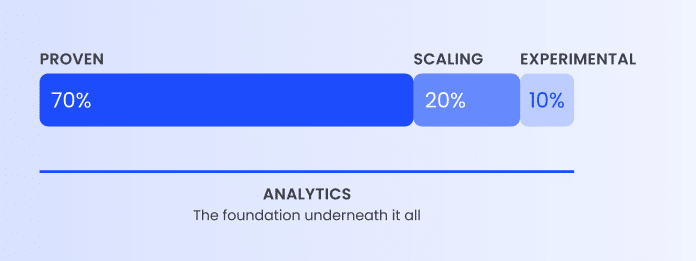
Because analytics functions as the foundation for any effective marketing budget allocation, it shouldn’t be viewed as an individual line item competing for resources. It underlies everything else, so it makes sense to think of it as a foundational layer, typically 5-10% of your total digital budget. Then allocate the remaining working budget using the 70/20/10 rule:
- 70% to proven, revenue-driving channels like paid media, SEO, and email
- 20% to scaling channels with early traction, such as video or influencer partnerships
- 10% to experimental tests like emerging platforms or AI-driven tools
Digital Marketing Budget Allocation by Channel
While there’s no single marketing budget allocation that will work for everyone, there are some benchmarks that are useful as a starting point. The table below reflects what we’ve seen work across B2B and B2C brands, from small businesses to enterprises. Treat the ranges as a starting point and adjust them to your goals.
Tier | Channel | % of Working Budget |
Foundation | Analytics Services | 5-10% of total digital budget, set aside first |
Proven (70%) | Paid Media | 30-35% |
Proven (70%) | SEO & Content Marketing | 25-30% |
Proven (70%) | Email Marketing | 8-12% |
Scaling (20%) | Video Marketing | 12-15% |
Scaling (20%) | Influencer & Creator Partnerships | 5-8% |
Experimental (10%) | Emerging Platforms & AI-Driven Tools | ~10% |
Analytics Services (Foundation)
Budgeting sufficiently to maintain high-quality analytics has to be the beginning of any effective marketing budget plan. The exact amount you’ll need to spend will depend on things like your need for attribution tooling, your data infrastructure, your reporting platform costs, and more.
What’s important is not to recklessly cut spending here because problems in this area will reverberate throughout your entire marketing function. After all, a simple analytics issue can lead to enormous amounts of waste everywhere else. That’s why investments here are typically wise ones.
Paid Media (Proven: 30-35%)
The amount you spend on paid media within the 30-35% range will depend on things like the cost of your competitive keywords, maturity of your account overall, and your platform mix between paid search and paid social. For example, if you’re a B2C brand that relies heavily on paid media to drive traffic, it will obviously be greater. If you’re a B2B brand that’s more reliant on long and heavy-touch sales processes, it will likely fall toward the lower end.
SEO & Content Marketing (Proven: 25-30%)
SEO and its newer AI-focused cousins are important and foundational marketing activities for nearly all businesses today. But where you fit within the 25-30% range will depend a lot on things like your need for technical SEO work, how much content you produce, and how much you may need to optimize (or re-work) your site and its content for AI search.
For those reasons, this portion of your budget will likely increase during setup or transition phases before decreasing during normal marketing periods.
Email Marketing (Proven: 8-12%)
Email marketing tends to fall within a more narrow range because of its low production overhead relative to the other channels on this list. But it will still vary based on factors like platform costs and the extent to which your email marketing is automated. That kind of automation may be a good opportunity to optimize here and free up resources for other areas within your marketing budget.
Video Marketing (Scaling: 12-15%)
Video marketing is increasingly important in a world where people consume more video content than ever. But it’s still a less important channel for most organizations. Like with email marketing, its costs tend to fall in a narrower range based on factors like production complexity. But there’s a lot of potential variation as video production can be extremely cheap and simple or very capital intensive depending on your approach.
Influencer & Creator Partnerships (Scaling: 5-8%)
Influencer and creator partnerships fit the scaling tier when they’ve shown early traction but haven’t proven consistent returns. Spend here depends on creator fees, the number of partnerships you run, and whether you put paid amplification behind creator content. Tie every partnership to measurable outcomes so you can tell which ones earn more budget and which ones to drop.
Emerging Platforms & AI-Driven Tools (Experimental: ~10%)
The experimental tier funds tests that might become tomorrow’s scaling channels. Examples include a new social platform, an AI-driven content or bidding tool, or an untested ad format. Set clear success criteria and a fixed timeline for each test before you launch it. Promote winners into the scaling tier, and cut the rest so the 10% stays available for new experiments.
Allocating Budget by Business Goal and Market Position
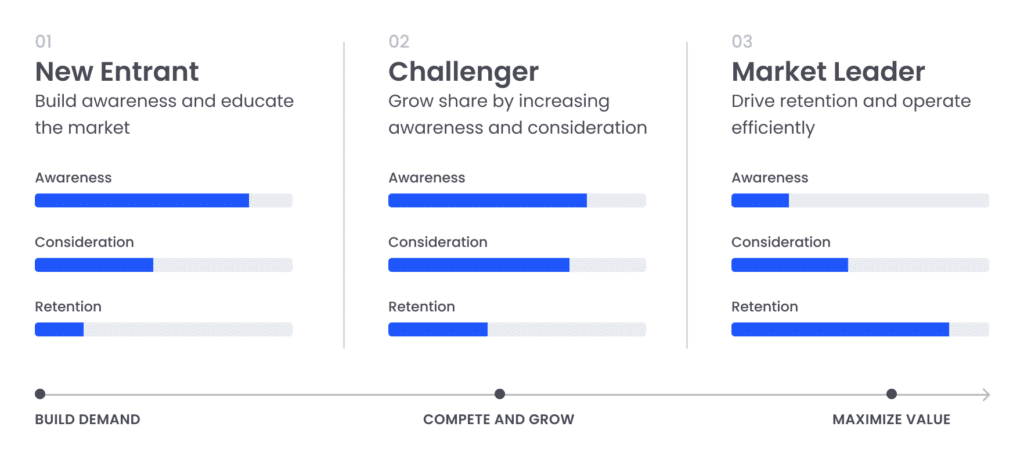
Alongside channels and funnel stages, your marketing budget allocation should also be based heavily on your business goals and market position. Starting with market position is generally a good idea because it’s the more structural variable. From there, you can break down your budget allocation based on specific strategic goals. Here’s how to think about your market position and factor it into your budget allocation strategy:
New Entrant
Unlike their more established counterparts, new entrants typically allocate their marketing budgets with a focus on things like category education rather than demand capture. Their prospects may not even know the problem the new entrant is solving exists, so they need to spend time educating those prospects and creating demand before working to capture it.
Challenger
While market leaders focus largely on maintaining their positions, challengers allocate resources with an eye on breaking into that leader’s territory. Doing that often means devoting more resources to things like awareness and consideration. Retention is still important, but the bigger goal is to reach the levels of awareness that market leaders have.
Market Leader
Market leaders typically allocate budgets with a focus on retention. That makes sense, considering they already have a large number of customers and there aren’t as many for them to chase out in the market. They don’t need to invest heavily in awareness because most of their prospects are likely aware of them already.
These businesses also tend to heavily favor efficiency in their marketing budgets. It’s easy to waste resources when operating at large scale, so that focus makes a lot of sense.

Allocating Budget Across the Marketing Funnel
Too often organizations build their marketing budget allocation around channels without taking funnel stages into consideration. That leads to a lot of wasted budget because resources aren’t allocated as strategically. A channel might be performing well and get more budget, but if that performance isn’t targeting the funnel stage you need it to, then much of that performance is an illusion.
Here’s how to think about funnels when building your marketing budget plan:
Top-of-Funnel (Awareness)
The core objectives of awareness operations within your marketing budget should be maximizing reach, building recognition, educating the market, driving initial traffic, and building retargeting lists for future campaigns. This is typically accomplished through channels like paid media, video, and SEO.
The resources you devote to this funnel stage will depend a lot on your market position and business goals, so be sure to factor them in when allocating budget.
Mid-Funnel (Consideration)
The middle portion of your marketing funnel is where you build trust, demonstrate your value, and strive to stand out from your competitors. Here, you’re explaining how your product addresses customer pain points, alongside nurturing and scoring leads, and ideally capturing emails and phone numbers to facilitate further touch points.
To accomplish this, you’ll want to invest marketing budget resources in paid media and retargeting, email marketing, as well as SEO and content.
Bottom-Funnel (Decision)
The last stage of the funnel is all about converting high-intent prospects into paying customers by resolving their final objections, validating their trust, and ensuring there’s minimal friction involved in the ultimate purchase process. Like with the other stages, paid media is important. But you also tend to rely on further retargeting alongside email and even Account Based Marketing ABM. Obviously on-page work to facilitate final conversions is also important at this stage.
How to Determine Your Total Marketing Budget
While allocating your marketing budget amongst various channels, funnel stages, and strategic business goals is important, you can’t ignore the need to determine what that total budget should be in the first place. There are five common models you can rely on to make that determination.
Percentage of Revenue
A common and fairly straightforward model for determining your overall marketing budget is by allocating a fixed share of revenue. Typically that share will be between 5% and 15% of past or projected revenue.
This approach works best for stable and mature companies with consistent profit margins because it helps prevent marketing costs from rising too quickly and outpacing revenue. However, it also hampers the aggressive expansion startups and new launches need because it naturally restricts the marketing spending needed for such growth.
Objective-Based (Bottom-Up)
For businesses with clear and measurable marketing goals and enough resources to devote to achieving them, the objective-based model can work well. It ties the overall marketing budget to specific initiatives required to achieve specific goals.
This model ensures resources are all tied to specific strategic goals, demonstrating clear value. That said, determining what those goals are and allocating your marketing budget based on them can be very difficult and time-consuming. Without historical data it can also be hard to have a sense of the budget required to achieve those goals.
Competitive Parity
If you’re operating in a stable and mature industry with similar products and predictable market shares, basing your marketing budget on what rivals spend can make sense. Doing so offers the benefit of defending your position, preventing the erosion of your market share, and avoiding costly ad wars.
This approach does rely on a few assumptions, for example that your competitors are setting their marketing budgets wisely. If that’s not the case, then you’ll simply repeat their mistakes. The competitive parity model can also lead to stagnation and tends to ignore hidden differences among market players like different goals, cost structures, or efficiencies.
ROI-Based
The ROI-based model for marketing budget allocation is deceptively simple: allocate resources to channels with the strongest proven returns. For ROI-based businesses with stable and trackable data tied directly to revenue, like e-commerce, this approach makes a lot of sense. Bear in mind that your ROI might not scale as your spending does.
However, this approach can be problematic for early-stage companies without historical data, those focusing on building brand awareness, and those with longer B2B sales cycles that break the short-term ROI math.
Zero-Based Budgeting
The zero-based budgeting approach requires every expense to be justified from scratch during each marketing budget allocation cycle. This helps prevent wasteful spending, links resources directly to goals, and pushes teams to prove value before getting resources. That makes it a solid choice for businesses making major strategy shifts, rapid growth, or those struggling with limited cash flow or flat performance.
The downside comes with the extensive amount of stress and work required to budget from zero each cycle. It also favors shorter-term benefits over long-term investments.
Reserving Budget for Testing New Channels
If your entire marketing budget is allocated without any resources set aside to test new channels, you end up limiting your ability to innovate and learn. That said, those testing budgets also need clear governance to perform at their best. That includes a defined testing window, specific performance thresholds set before funding, and clear rules around when they should scale and when they should end. This helps prevent tests that end up running indefinitely and wasting vital resources.
In other words, setting aside a reserve budget for tests is important but only when it’s done consciously. These tests aren’t places to make it up as you go, structure and thoughtful planning are necessary to get the most out of those resources.
Building an Integrated Budget Strategy Across Channels
We’ve said it before and we’ll say it again: an integrated and holistic approach that works across channels is far better at achieving strategic goals. Instead of funding channels in isolation, you should combine them so they can work together to achieve greater goals. Here are some ways to do that more effectively:
Why Channels Shouldn’t Be Funded in Isolation
When they work together to achieve the same goals, channels like SEO, paid media, content, and CRO are greater than the sum of their parts. Each one helps make the goals of the others more achievable. For example, good SEO makes it easier for people to find your content. That content can gather customer profiles for retargeting with paid media, etc. Starting with your goals and thinking about how channels can work together to achieve them just makes everything easier.
What an Integrated Strategy Looks Like in Practice
Let’s illustrate how channels can work better together with a real-world example. Let’s say a business wants to enter a new segment and is trying to allocate its marketing budget to achieve that goal. One approach would be to set aside a budget to various channels and just ask them to each try and use that budget to achieve this goal.
The problem is that this approach begins with the budget and goes from there. Instead, by starting with the question of how to enter that new segment and an idea of the total budget you have you can figure out how each channel can support that endeavor and allocate budget accordingly. In this case, the resources each channel has are directly linked to their ability to help achieve that ultimate goal. It also makes it easier to think about how the channels can support each other instead of operating in isolation.
Build Your Marketing Budget Strategy With Session Interactive
The big takeaway here is that a strategic approach to marketing budget planning and allocation offers a wide range of benefits. Instead of relying on a marketing team or agency to optimize individual channels, bringing in a genuine strategic partner who can combine analytics, SEO, paid media, content marketing, and CRO into a custom strategy built around specific business goals makes all the difference.
Here at Session Interactive, we are that strategic partner. If that sounds like what your business needs, get in touch.
For over 15 years, Session Interactive has helped businesses across a variety of industries align their marketing budgets to drive measurable business outcomes. From auditing analytics to deciding which channels provide the best ROI, we make sure every allocation decision is backed by data you can trust. We combine seasoned digital marketing expertise across a variety of services to build integrated budget strategies where every channel works toward the same goals.
Ready to see where your budget should go?