


The Cost of Choosing the Wrong Digital Marketing Agency
It’s helpful to understand both why working with the wrong agency is such a problem and how to tell if you’re in that situation. Depending on the size of your business, average annual spending ranges from $18,000 up well into the 6 figures. Yet despite that spending, 72% of companies are dissatisfied and 40% plan on switching.
In other words, companies are spending enormous amounts of money on services that are not meeting their expectations. While not all agencies are great themselves, the issue is often a mismatch between the agencies and their clients.
Signs You’re With the Wrong Agency
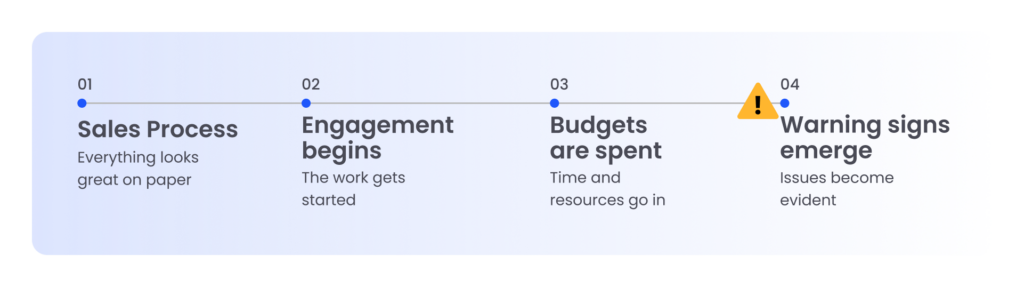
If the costs of working with the wrong agency are so high, how can you tell if you’re in that situation? While the initial sales process is designed to minimize visible risk for you as a client, the real issues typically show up later. It’s only when budgets have been spent that you start to see warning signs like:
- Lack of communication: Any good agency should prioritize prompt, clear, and transparent communication with its clients. If you find that emails are going unanswered consider that a major sign of an agency that isn’t the right fit.
- Zero transparency: Whether through direct communication or the open sharing of information about work, results, etc. you want to work with an agency that’s open about what it’s doing and why.
- Expectation gaps: Setting and then meeting expectations is a core part of good marketing agency work. If yours is consistently falling short, they’re probably not right for you.
- Guarded access: If an agency is trying to restrict your ability to freely see what they’re doing on your behalf, you should be concerned. Transparency is the foundation for a good partnership.
- Unrealistic promises: This is a red flag you can spot very early on. If an agency guarantees specific results or seems overly confident it can deliver something unrealistic, be careful.
- Missed timelines: While it’s understandable that things go wrong on occasion, if an agency is consistently missing its timelines then you should likely consider alternatives.
- Lack of strategy and ROI focus: Even if an agency is meeting deadlines and working hard, if there’s no strategy to ensure that work translates into real ROI it’s likely wasted effort.
- Consistent performance issues: While raw performance isn’t everything, as strategies can take time to deliver results, if expectations aren’t being met for long enough that’s a sign to move on.
Criteria for Selecting a Digital Marketing Partner
Armed with a solid understanding of what the wrong digital marketing agency looks like, what criteria should you use to avoid those issues? I break it down into five distinct areas where you can directly evaluate any prospective partner.
1. Revenue Focused Strategy
The list of potential metrics you can use to evaluate marketing performance is nearly endless. The wrong ones can lead to work that just doesn’t produce results. What you want to look for is an agency that understands your business goals, competitive position, and current performance before developing a roadmap built specifically around your strategic goals.
In practice, that generally translates into a revenue focused strategy. The focus on revenue helps you avoid vanity metrics and really focus on what matters: real revenue now instead of potential revenue in the future.
2. Analytics Depth
Having a revenue-focused strategy is great but without quality analytics there’s no way to know whether it’s really delivering. And if you don’t have that information, your strategy can’t iterate and evolve.
Real analytics depth means relying on a single reconciled source of truth for organic, paid, and conversion data that’s openly available to you as a client at all times. This transparency helps build trust, ensure you’re on the same page, and enables both parties to rely on that source of truth to find the right strategic direction.
3. Cross-Channel Execution
Modern marketing success doesn’t come exclusively within a single channel. Successful revenue focused strategies require cross-channel efforts spanning SEO, AI search, paid media, content marketing, and conversion rate optimization (CRO).
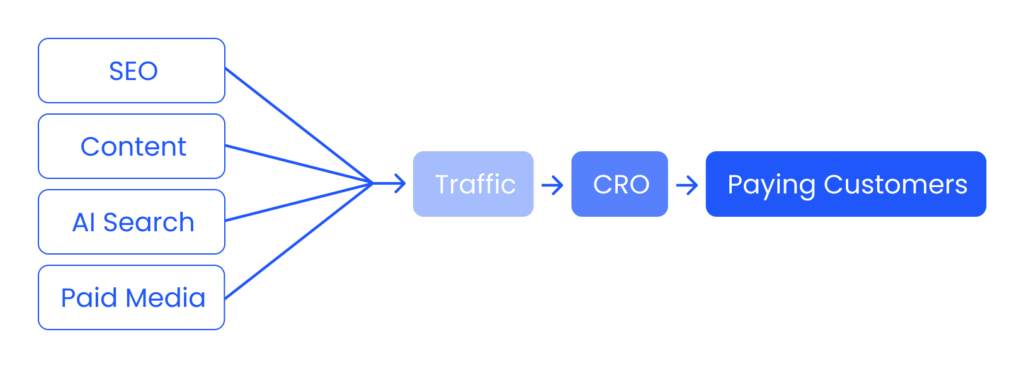
These channels mutually reinforce each other. Search, content, and paid media bring traffic that CRO turns into paying customers. SEO helps content, content helps AI search, and on and on. When each channel is performing at its best, you get a strategy that’s greater than the sum of its parts.
4. Consistent Success
Plenty of digital marketing agencies can put together a pitch that sounds like it meets all these criteria. The difference comes with its ability to translate that strategy into consistent results across different clients and industries.
That’s what proves an agency’s strategic approach is delivering results. It’s why a good agency should be ready to show case studies and generally be open about how and why their approach has worked over time.
5. Transparent Communication
While it can take time to see whether an agency’s strategy can deliver the revenue you want, communication shows you what kind of partner an agency is right away. If an agency isn’t willing to be open and transparent about their processes, pricing, timelines, expectations, and internal people doing the work, that should raise serious alarm bells.
This is true not only because transparency builds the trust that’s so vital for a successful agency partnership, but because it’s also essential for successful cooperation. Without knowing what’s happening, you’re less able to drive improvement and find better ways to operate.
Comparing Digital Marketing Agencies: Quick Reference
Evaluation Criteria | What to Look For | Red Flag |
Revenue Focused Strategy | Agency delivers a roadmap prioritized by revenue impact, with clear sequencing of what happens first and why | Deliverables described as a task calendar with no stated business priority behind the order |
Analytics Depth | Agency owns tagging, data accuracy, and unified reporting infrastructure, and provide access to custom dashboards | Reporting consists of screenshots pulled from each platform with no single source of truth |
Cross-Channel Breadth | A team that can speak with specificity across SEO, paid media, content, and CRO, and explain how decisions in one affect another | Separate specialists per channel who can only speak to their own service line, or core disciplines quietly outsourced |
Consistent Success | Case studies, references and third-party reports show strong outcomes across multiple, varied client engagements | The same one or two flagship case studies reused regardless of the buyer’s industry or need |
Transparent Communication and Partnership | Agency gives clear visibility into process, pricing, timelines, and direct access to the people doing the work | Guarded access, vague expectations, unrealistic promises, or missed timelines with no proactive communication |
Digital Marketing Agency Partnership Models
Even when you’ve found the right digital marketing agency, the way you structure your relationship is vital for success. Using the right partnership model helps align your interests and ensure you both end up satisfied with the relationship. Be aware that less expensive isn’t necessarily better, it’s all about incentives and long-term results.
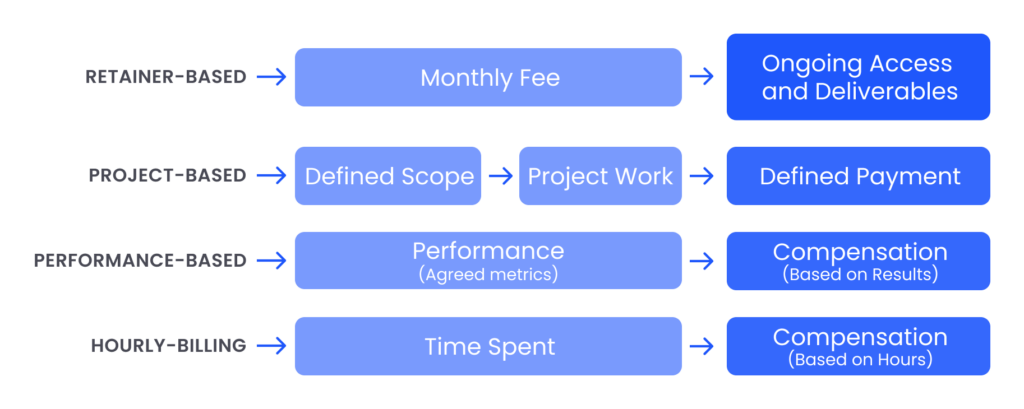
Here are four common partnership models along with the advantages and disadvantages of each. Use them to help determine which makes sense for your needs.
Retainer-Based
A retainer has you pay a base fee every month in exchange for guaranteed access, time, or a specific set of deliverables. This creates predictability and ensures the agency has resources when you need them. For example, if you want to hire an agency merely to provide ongoing advice and expertise for your internal marketing a retainer might make sense.
However, retainers don’t align interests very well as the agency gets paid regardless of the results. Retainers are also quite rigid so it can be difficult to adjust them if your needs change.
Project-Based
Another model is project-based work. Here, you set a defined scope, timeline, budget, and deliverables for individual projects as they arise. That might be for a specific campaign or something like revamping your website.
Project-based work is ideal for one-off engagements where it’s possible to set out the parameters at the beginning. It gives you structure and predictability. But it also limits how an agency can help, as their work is limited by those same parameters. That said, you can also shift to another model once that project is concluded.
Performance-Based
Performance-based partnerships excel at just that. Compensation is directly linked to performance, meaning both sides share in that upside. So for example, an agency might get paid for each conversion it delivers.
But for this to work you need good attribution and analytics along with a lot of trust and transparency. It’s also important to remember that the agency takes on more risk with this model so you will probably pay more for that performance to offset that risk. One of the most important elements of a partnership model is aligning incentives.
Hourly Billing
This is the simplest and most straightforward partnership model on this list. Hourly billing is just what the name implies: you pay for the time the agency spends working for you. However, that bill will be the same whether that work produces results or not, so this model isn’t as good for aligning incentives.
But it can be a good starting point when you’re still working out the scope of the relationship and the goals you want to achieve. It’s also ideal when you want maximum flexibility to use as much or as little agency resources as you need month to month.