

Marketing leaders trying to use AI for conversion rate optimization are bombarded with advice designed to sell them on a particular tool. Truly understanding how to boost conversion rates using AI tools requires stepping back and understanding the fundamentals outside of a specific program or tool.
Fortunately, we’ve been doing AI conversion optimization long enough to draw some insights that will help you get the most out of your own AI CRO.
In this guide:
Key Takeaways
- AI CRO tests multiple variants at once and shifts traffic toward winners, surfacing results in days instead of weeks
- AI tools learn from raw data in real time, so clean analytics and upfront bot filtering are essential
- Sites without enough traffic to reach statistical significance are better served by manual A/B testing
- Confirm your conversion tracking is accurate and run a single-page pilot before rolling out sitewide
- Have a person review every AI-selected winner to catch brand or business conflicts the data can’t flag
How AI CRO Differs from Traditional CRO
The first and most important thing for marketing leaders to appreciate is how AI conversion rate optimization differs from its traditional counterpart. These differences have an enormous impact on how you’ll execute CRO going forward. Here’s a breakdown of the basics:
Factor | Traditional CRO | AI CRO |
Testing method | One hypothesis tested at a time | Multiple variants tested in parallel, continuously |
Traffic allocation | Split evenly (e.g., 50/50) for the full test duration | Shifts dynamically toward the current best-performing variant (a “multi-armed bandit” approach) |
Time to results | Typically 3-6 weeks to reach statistical significance | Directional signal often visible within days |
Personalization | Same experience shown to a broad segment or all visitors | Experience can be tailored to individual visitor signals in real time |
Oversight needed | Manual setup, monitoring, and analysis at each step | Automated setup and monitoring, but still needs human review of outcomes |
Testing Method
AI conversion rate optimization’s unique testing method enables you to test multiple hypotheses at the same time. Compared to traditional CRO, which requires you to test ideas one at a time, AI enables you to save an enormous amount of time.
For example, you can test three variations of a headline and two variations of a layout simultaneously. Previously, you would have had to first test the headline variations before then testing the layouts.
Traffic Allocation
One of the ways AI tools are able to test hypotheses more efficiently comes from how they allocate traffic. For example, instead of simply splitting traffic 50/50 between two variants during an entire test, an AI CRO’s “multi-armed bandit” algorithm will shift traffic toward the winning variant as the test runs. This enables you to avoid sending users to a poorly performing variant, and handles multiple variants far more efficiently.
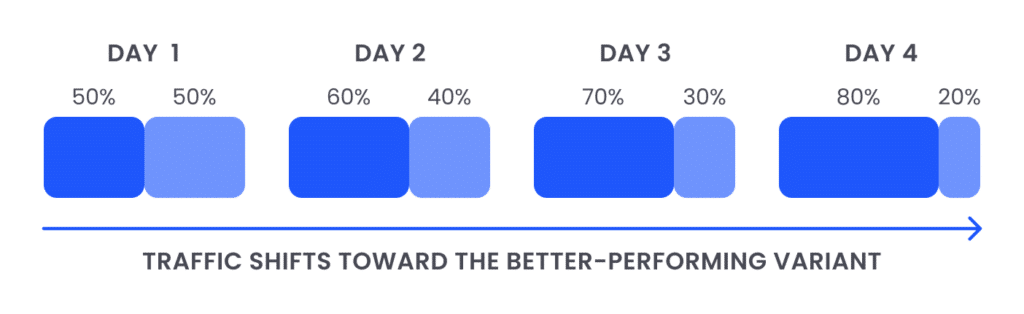
So traffic may be allocated 50/50 on day one of the test but shift to 80/20 in favor of the better-performing variant by day four.
Time to Results
The ability of AI CRO tools to shift traffic toward better-performing variants means you can often see which direction a test is heading within days instead of the 3-6 weeks a traditional test typically needs. Confirming a result with full statistical confidence may still take longer, but acting on early signals lets you limit the traffic sent to underperforming variants while the test runs. Compound that across multiple tests, and the time saved adds up quickly
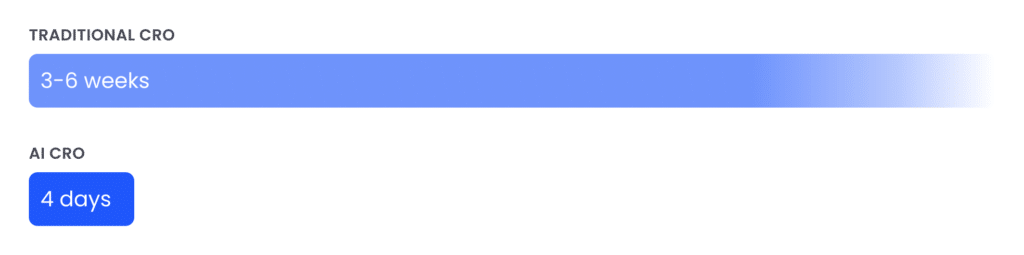
So instead of waiting five weeks for a checkout page test to conclude, you might see a clear leader emerging within four days and start shifting traffic toward it while the test continues.
Personalization
AI conversion rate optimization tools offer far better personalization compared to their traditional counterparts. Instead of simply showing every visitor within a specific segment the same variant, AI CRO can tailor experiences to individual customers in real time. For example, a returning visitor might see a different ad headline than a first-time visitor. That provides more and better quality data marketing leaders can leverage.
Stephen Ngo, Director of Growth Marketing at Crazy Egg, put it directly on Built to Convert: “What if we could deliver the right message to the right person at the right time? That technology exists now, so we should go build it.”
Automated CRO
Marketing leaders know that one of the biggest investments in CRO is the time needed to manually set up, monitor, and analyze results. Those steps take time and introduce opportunities for human error. AI conversion rate optimization tools can automate these stages so tests run continuously without the need for human intervention at every new step. As a result, marketers can focus their attention and efforts on other areas.
As Ngo described it, “We used to have more data than we knew what to do with, so we’d throw it in a lake and wait for someone to look at it. Those days are over. Analysis is no longer the bottleneck. Figuring out what to actually do with it is where we run into bottlenecks now.”
Why CRO Depends on an Analytics Foundation
Although AI CRO tools are distinct from analytics tools like Google Analytics, the two are deeply interconnected. The reason boils down to an old saying around AI algorithms: garbage in, garbage out. The outputs of an AI conversion rate optimization tool are only as good as the quality of the analytics inputs.
That’s why before you even start trying to select or implement an AI CRO tool you need to ensure your analytics setup is in good shape and you have enough data to work with.
“The more data you have,” Ngo said, “almost always, the better.”
How CRO, Analytics, and AI Fit Together Across the Funnel
Analytics establishes visibility across the entire funnel, capturing traffic sources, engagement patterns, and conversion behavior from awareness through retention. CRO applies at the narrower points where a conversion action exists like a loan application, an account opening, or a rate calculator submission. AI extends both by detecting patterns across larger data sets and enabling faster, more targeted testing than manual methods allow.
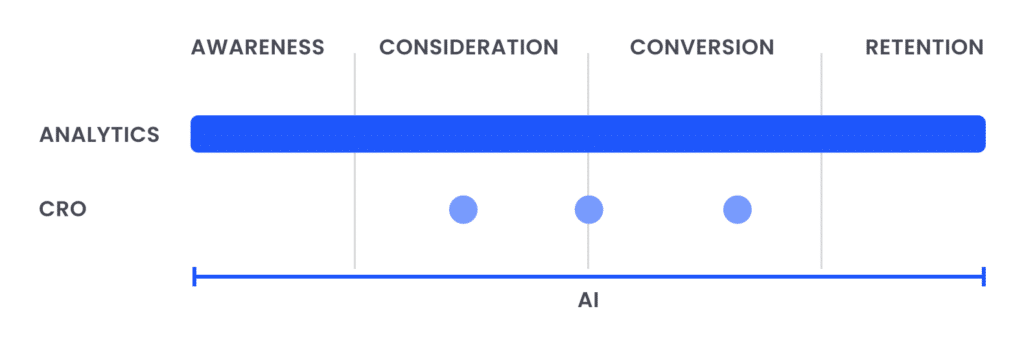
Consider a credit union where analytics shows mobile visitors converting on HELOC applications at a higher rate than desktop, and applicants who use the rate calculator first showing higher approval rates. AI-powered CRO testing then focuses directly on optimizing the mobile flow and surfacing the calculator earlier for qualified visitors, concentrating testing resources on the segments most likely to drive loan volume.

Predictive Analytics and AI CRO
High-quality analytics is an essential foundation for AI CRO, and also factors into how those same AI tools can leverage predictive analytics throughout the funnel. These tools typically use the same algorithms they apply to CRO for things like retargeted ads, deciding which version of a page a specific visitor is likely to convert on, and automating email flow optimization.
The key thing to remember is that the high-quality data and analytics you need for AI CRO are also necessary for those other functions. Those incredible predictive capabilities modern AI marketing tools bring can do a tremendous amount, but it all rests on quality data.
Analytics Quality and AI CRO
One of the first ways to ensure you’re working with high-quality analytics data for your AI CRO is thinking about non-human traffic. A large, and increasing, share of internet traffic is now made up of things like bots, scrapers, and other automated scripts.
These are often very important as they’re how your site gets mentioned in places like LLM conversations, but they also pose problems for AI CRO. Here are some questions you should ask:
Is Bot Traffic Filtered Before or After a Conversion Event Fires?
Assuming that you can simply identify and filter out non-human traffic later is a big mistake. The reason boils down to the fact that AI conversion rate optimization tools learn from raw data as it comes in.
So even if you clean up that data later, the AI has already drawn lessons from it and implemented those lessons. That’s why you always need to ensure traffic gets filtered before the conversion event is recorded.
Is There Enough Real Traffic to Detect a Genuine Lift?
Even considering the way AI conversion rate optimization tools use traffic allocation to draw conclusions quickly, they still need enough traffic to make reliable decisions. Statistical significance is vital here because it’s the only reliable way to know whether something is a genuine signal or just noise.
Ignoring that can result in optimizations made based on nothing more than random chance, wasting time and resources on what’s essentially a random coin flip. The AI CRO tool you use should have some guidelines to follow, so pay attention to what they are.
Is a Person Reviewing What the AI Decided Before It Goes Live?
Statistical significance may be the gold standard when it comes to data-driven decision making, but it’s not everything. For example, it could be that the best performing subject line of an email conflicts with your brand guidelines or misleads your customers.
That’s why fully removing humans from the CRO loop is not wise. You’ll want to have a manual review by a human before a CRO campaign goes live just to flag any potential issues and avoid problems down the line.
Does the Result Account for Visitors Who Didn’t Consent to Tracking?
While bot traffic needs to be filtered out before it reaches your data, some human visitors also remove themselves by declining to be tracked. This is increasingly common as regulations like the EU’s GDPR make it easier for users to remove themselves from behavioral data.
The result is that these users will not factor into your conversion rate calculations. That may or may not affect the ultimate decisions you make, but it’s worth being aware of.
How to Use Artificial Intelligence for Conversion Optimization
Once you’re confident in the quality of your analytics data, there are a few remaining steps you should take to ensure you end up with quality results.
Match the Tool to Your Traffic Volume and Funnel Stage
Determining which variant is statistically significant in a CRO test requires a certain amount of traffic. The more traffic, the faster that result will come and the more reliable it will be. Most AI CRO tools require around 10,000 sessions to make a solid determination. If you’re below that threshold, manual A/B testing and direct user research are likely the better approach.
Confirm Your Tracking Is Accurate Before You Start
Because quality data is absolutely essential for any AI conversion rate optimization tool to work properly, you should check your tracking before implementing one. For marketing leaders, that means confirming that every important conversion action like form submissions, purchases, and signups. is being tracked correctly. Any issues here will reverberate widely once the AI CRO tool is up and running.
Run One Contained Pilot Test Before Rolling Out Sitewide
Even if all your tracking seems to be working, it’s worth running a contained pilot test with an AI CRO before implementing it sitewide. Start by selecting a page to run the test before using the AI CRO tool there. Once you have your results, scrutinize them closely and double check everything. It’s far simpler and easier to find and fix problems at this stage rather than doing so once the tool is active sitewide.
Have a Person Review Every AI-Selected “Winner”
A common mistake when using AI for CRO is allowing the AI tool to automatically implement the winning optimization. The problem comes when that optimization doesn’t fit with other campaigns, your brand guidelines, or your existing business context.
For that reason, you should always have a human manually review each AI-selected “winner” before it gets implemented. Even if you only spot an issue every once in a while, this step is well worth the effort.
“There’s still room for human judgment in there,” Ngo said. “Give me a bunch of ideas on which optimizations are on-brand, and I can look at it and say, sure, those are the five obvious ones, but here are three more nobody’s thought of yet.”
Conclusion
AI CRO can dramatically shorten the path from hypothesis to result, but only when the fundamentals are in place. Clean analytics, sufficient traffic, accurate tracking, and consistent human review are what separate reliable gains from fast mistakes. Getting those pieces right takes time and experience, and that’s where the right partner can make a difference.
For over 15 years, Session Interactive has helped organizations in financial services, eCommerce, and B2B turn their marketing data into measurable business outcomes. From auditing analytics to piloting and scaling AI-driven tests, we make sure every decision is backed by data you can trust. We combine seasoned digital marketing expertise across a variety of services to deliver real results.
Ready to see what your data can do?